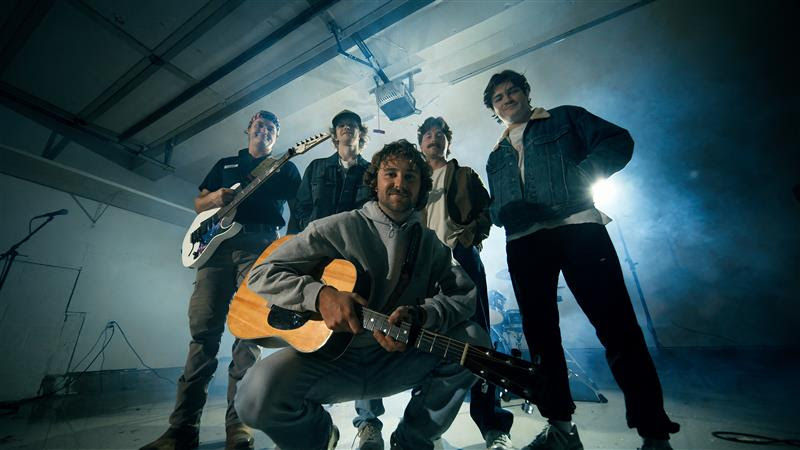
Thomas O'Shea Turns Work Frustration Into Wildly Creative Fire With The Undeniably Catchy "The Truth"


By: Miles Carter
The Cage: We got together with Thomas O'Shea for an exciting interview to delve into the stories and happenings behind the making of this latest release and learn more about the artist in "The Cage" Digital Magazine and we are excited to share it with you!
Begin Interview:
Hello Thomas O'Shea, we’re thrilled to have you here for this interview! We've had an amazing time exploring your music and diving into your creative journey. Now, we’re even more excited to get a deeper look into both your brand and your personal and professional inspirations.
Thanks for having me!
The Cage: This song holds back nothing. It is a pull-no-punches bark at the world of work, toxic bosses, and the pressure of pretending everything is fine. The jazzy flow and unique delivery make the whole song hit in such an incredible way. On paper, it is almost hard to explain, but once the flow of “The Truth” kicks in, it becomes undeniably catchy, wildly creative, and completely memorable. We loved it.
Q. Our first question has to be, do you still have this job, and does anyone there know you made “The Truth” and that it might be about them? In some possible way, does that kind of frustration fuel your creativity, or does it only bring pure aggravation?
A. I definitely am not at that job anymore haha. I stay well away. As for if they know it’s about them, I don’t think so but I honestly don’t care. First off, I busted my ass for that gig only to be underpaid and (in the end) was treated like the bottom of the barrel. And second, it really is only one person, and not the place itself. While I portray the job in “The Truth” as a full time thing, the reality is that job was supposed to be a small piece of what I did, but eventually it was the thing that killed my love for live sound production. As for the fuel for my creativity, songwriting has become my way to vent. So I would say that writing “The Truth” actually PREVENTED pure aggravation. Sometimes, like in this case, my songs are a “what I would have done if I didn’t have control over how I handle myself” type thing- to let out the pent up feelings. The anger felt in “The Truth” is because this job single-handly spiked my anxiety and poor mental health habits, destroyed my love for mixing live, and made something that should have been fun flip into a burden to do every week- and I didn’t acknowledge the issues until I was let go.
Q. Thomas, you are involved in so many incredible parts of music as a producer, mix/master engineer, artist, and former live sound engineer. What first drew you into the music world beyond performing or playing instruments? When you look at all of these titles, which one do you enjoy the most right now, and why?
A. Originally, I was a classical musician. I did the competitions, awards, auditions, and everything. But I would gravitate to anything musical whether it was classical or not. The first step into production, engineering, and collaborating started at the beginning of high school when my choir teacher, Anthony Cao, taught a music production unit in class. I had no idea what I was doing but just never stopped which prompted me to learn the ins and outs of the industry and that led to me finding opportunities to make this my career. As for how I got into engineering and live work, while I was in college, I was trying to find every opportunity available to me so I went to the student union and applied to be an AV Tech/ IT guy. That was not the work I was interested in, however. The AV techs also set up, mixed, and troubleshooted all the campus funded activities. And because of my work in school, I was able to find similar work at home in Madison, WI during breaks. Having these opportunities plus working on my audio production and music business degree allowed me to practice what I learned in the classroom which I credit as the reason why I can switch between live and studio production work.
As for titles, I like most of what I do in the industry, but I’m mainly working on building up my portfolio as a producer and mix/ master engineer. I started a business called OK Hit Record Productions LLC, and while we don’t offer recording YET, this business has become the main goal. I love working with artists and bringing out the best in them. I also like the idea that people can find and connect with my work because I worked with their favorite artists. And I believe my skill set compliments that goal. Honestly, because I enjoy so much of what I do right now, the ideal would be similar to what Jon Bellion does- a main focus on writing and producing and mixing for other artists while also releasing solo music that’s unlike anything else I work on. My favorite part isn’t the title- it's the process. And it doesn’t matter to me what part of the process I’m brought in on. I’ve produced records, produced and mixed, and even simply just added some post production on records or live recordings here and there.
Q. We have never been to Madison, Wisconsin. Do you feel Madison has had a positive or neutral impact on your career? Is there a strong live music community or creator culture present there?
A. That’s a kind of hard question to answer. Not because the music community in Madison is bad- quite the opposite really. But I rarely work with people here in Madison. Connections wise- it’s amazing because I interact with people from backgrounds wildly different from mine. It’s cool to network and get to know musicians around here but most of my current clientele are from the “music hub” cities like LA, New York, and Chicago. The music community here is pretty tight knit but always changing because a lot of the attention is on student bands from the university. There are a handful of ever present local bands but even with my 5 year tenure as a live engineer, I’ve only worked with a handful of them. Madison is one of those places that seems both small and big at the same time, so there are probably loads of artists and bands that I have never heard. But, I can say there is a very nice emphasis on music in the community. There are many specialty venues/ bars that host a lot of great music events. Most weekends it’s difficult to find only one show to go to because so much is happening- especially when the University of Wisconsin students are around. There’s a few jazz venues, metal/ hardcore rock venues, dueling piano bars, outdoor venues, university hosted events, and so much more that give local artists and bands opportunities. But, at least from what I have seen, the people that end up wanting to record and perform as their full time leave for the “hub” cities or go on extended tours regularly.
Q. You mention pop, hip hop, R&B, and EDM as part of your sound. Do you have a preference among those genres, or does each song pull from whatever inspiration fits the moment? With “The Truth” carrying such a powerful message, is that usually the type of music you create, or does every song have its own emotional center?
A. Since I started writing my own music back in 2016, I have tried each of these genres on its own but every time I did, it never truly felt like me. My EDM stuff sounded like a wannabe Skrillex without the intricate details. My hip hop sounded like I knew how to produce but I was insecure as a writer. And my R&B and my pop sounds were just kind of bland in my opinion. So when I rebranded in 2024, I decided to push together what I had already been trying to do- and stop holding back. I listen to each of those genres equally and regularly work with pop and hip hop artists (of which I’m always looking for more) but I don’t know if I would say that’s a preference. I would say that I’m all about putting the song first. If the song should be delicate while holding back anger (like The Truth) then I need production and writing that matches. But, if I want a big instrumental break or an artist I’m working with likes that kind of sound, then I’ll produce a drop with big synths or heavy bass. It depends on what the song needs. I think this is one thing I can thank working with rock and hardcore as much as I have as a live engineer- cause I never leave that kind of style off the table in the studio. Even though it doesn’t match my personal sound, I’m able to work with those styles a lot better now, which gives me even more to play with while working with artists or writing solo music. All that said, each song definitely has its own emotional center- and a lot of times its drawing from sounds I otherwise wouldn’t have worked with thanks to my background.
Q. After being inspired by the church pianist on Sundays, starting piano lessons at age six, singing at age seven, making your first beat at 13, and writing your first song under the alias TY'O at 14, are there any other instruments or areas of music creation you still want to master as part of your skill set?
A. Oh most definitely. I’m always learning. And I’m always in search of artists that I can produce or mix for that will push my own creativity. In my free time I’ve been teaching myself guitar and have been slowly incorporating guitar in my work. I’m also always in search of just cool sounds. One of my favorite things to do is find the most out there sounds possible and to make music using those sounds. In fact, in college, after my senior recital, I would frequently say that my main instrument was Pepsi- because I produced a full edm song using only a Pepsi bottle, a mic, and my Macbook. Something I’d definitely like to dive into more is writing in a group. I have only tried songwriting in a group one time- and we didn’t even finish a song. While I HAVE written music with my (former) band, that was where each person wrote their own part and worked together on putting it together into a full song. I also want to work with orchestral instrumentalists more. I don’t know if I would want to PLAY those instruments myself (I tried playing a horn in college and I sounded like a dying animal…), but the handful of times that I got to work with strings players or horn players are some of my favorite memories of working with musicians in person as opposed to remotely. Plus working with a real recording of strings or horns is a hell of a lot more enjoyable than midi! I’m also always trying techniques that i see in “how it was made” videos. For example, my last album, Generation Z, has production inspired by Charlie Puth and Jon Bellion- specifically beatboxing and making sounds with my voice to fit the drum beats.
Q. It is very obvious you are an accomplished person. You earned a degree in audio production and music business, plus a certificate in music composition from the University of Wisconsin Oshkosh. How have those educational accomplishments helped shape who you are, and what skills from that experience do you find most important in your creative work today?
A. I really owe everything to the music program at UWO. I found my people who pushed me to be a better musician- both my professors and my peers became friends and collaborators and pushed me out of my comfort zone so many times that I got comfortable with it. This I find to be extremely important because in music if you’re too comfortable then nothing gets done- that’s my experience anyway. UWO gave me a space and mentors who helped train my ear both as a musician and as a producer and engineer. Being able to quickly identify keys and melodies is one of the most beneficial things that I learned at UWO- in one of my least favorite classes (at the time) too! UWO also taught me how to work with others and how to pull back and listen to my work as a consumer and not as the composer. This is a skill that I’ve noticed isn’t as common as you’d think- but I believe is the reason why I went from over producing everything I did to critically listening and only adding things that add to the song to avoid too much in the mix. I also have a much better understanding of the music industry and how to make money. And finally, after studying music of all kinds from many different time periods and cultures, I can draw from history to find public domain samples to interpolate or make informed decisions to push a song to be the best it can be.
Q. Could you share some moments or takeaways from your experiences working with Billboard-charting and Grammy-nominated producers, along with mentors like Dr. Eli Kalman, Dr. Ed Martin, Dr. John Mayrose, and Nathan Edwards? What advice would you give to a young artist, producer, or engineer who could benefit from the kind of guidance you received?
A. Working with other producers meant being extremely proactive and effective at finding their contact and hopping on every opportunity. In all honesty, it isn’t hard to do at all in the way the industry runs now. As long as you have an internet connection, an outgoing attitude, and you never give up, you’ll end up finding really cool people to work with. Working with successful producers did teach me a lot of valuable lessons about work ethic, networking, and realities in the industry that were some hard truths to face. The biggest lessons from working with producers more successful than me are the sheer number of outputted material and the fact that dry spells with not a lot of money coming in is normal. I also learned to change my perspective on “bad” recordings. What you might think is your worst work others might love. So send EVERYTHING out!
My mentors in college are the reason why I can confidently do what I do.
Dr. Kalman would teach in a way that would either break the tension or cause more. And this was actually a good thing that helped me work out my nerves on stage and my confidence as both a musician and a human. One of my favorite moments that I think about a lot was when I had to perform a classical piano piece (I think it was a Debussy piece?) and his only comment was “you sound like you’re playing in a tunnel and you see a light. But you can’t tell if that light is the opening to the other side or… a train.” While it sounds like a “wth does that mean?” kind of comment, it taught me the lesson to always play (and therefore write) with a confident intention. If you want to put something in your work do it with intention and a firm understanding of why you’re doing it.
Nathan Edwards is the reason why I decided to go to UWO. As the music industry and audio production studies director, he and I worked very closely together on developing my ear and my understanding of production, mixing, and music. Something I took away from working with him is that every artist, every session, and every song is different. While I sorta already had this in the back of my mind, getting to work on something new every week with Nate in the lead taught me to be prepared for anything- including a lot of running in order to complete something in a short amount of time.
Both Dr. Martin and Dr. Mayrose were my composition mentors. While it's hard to find one single moment- especially because both have slightly different teaching styles and the music that came out of my lessons with both of them were slightly different- I had a few overall takeaways. The first is writing with intention and a clear plan in mind- whether that be a story, a person, or simply just an idea. I either draw out what I think a song should be on paper or keep detailed notes about what I’m doing with a song. The second is organization. Multiple times, in different semesters, working with one or the other each semester- I accidentally lost FULL projects or lost a substantial amount of work from the week because I was terrible at organizing and hitting save. This prompted a LOT of catchup work as a lesson. Now, I save like it’s my full time job and keep detailed notes with folders and notebooks so that I never have to worry about opening a project and not seeing what I had done the day or week before- cause that sucks.
Q. If you had just one wish to fulfill, and a label gave you the opportunity, would it be performing at a major festival, working with any artist of your choosing (no matter how famous - and if so- who?), or something else entirely? Basically, what is the next big goal for Thomas O'Shea in this journey?
A. All I really want is to live fully off my production and mixing work so that I can stop all the little side gigs. While I enjoy the side gigs for the most part, whether that be education or supporting students running live shows (I say I’m a former live engineer but I do have my hand on a handful of shows here and there just not mixing them myself) every time I’m at one of those gigs, I’m thinking about the dream of living solely off what I set out to do a full decade ago. But, if I had to choose one big goal, it would probably be to score a movie or TV show. One of the things I’m all about- no matter what I’m doing or who I’m working with- is storytelling with music. And scoring a big story like a movie or tv show would be the ultimate huzzah for writing to tell a story. And because I’ve worked with so many different genres- I think that would work in my favor to incorporate different styles into a movie or tv show score to accurately portray characters and motives.
The Cage: Thomas O'Shea, thank you so much! We appreciate you taking the time to talk to us.
End Interview
We’re happy to have shared Thomas O'Shea’s exciting journey with you and uncovered such inspiring insights about their creative process.
Tap in below and experience it for yourself