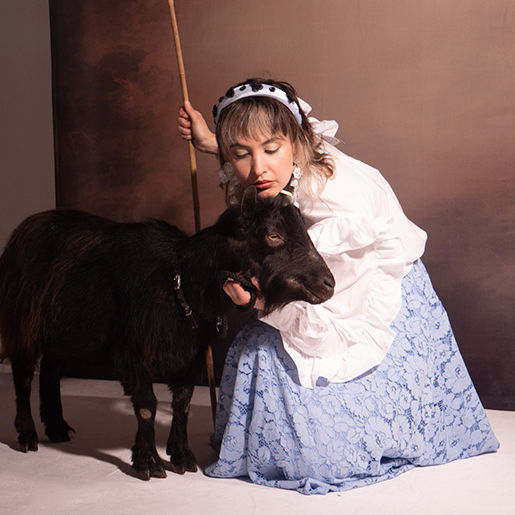
Salwa Delivers A Mesmerizing, Commanding, And Deeply Reclaimed Artistic Triumph With "GOAT"


By: Miles Carter
Salwa turns “GOAT” into a bold and emotionally connected transformation, where dark electro-pop, cultural memory, and personal power collide with showstopping force.
We got together with Salwa for an exciting interview to delve into the stories and happenings behind the making of this and learn more about the artist in The Cage digital magazine and we are excited to share it with you!
Here’s how it went:
Begin Interview:
The Cage: Hello Salwa, we’re thrilled to have you here for this interview! We've had an amazing time exploring your music and diving into your creative journey. Now, we’re even more excited to get a deeper look into both your brand and your personal and professional inspirations.
“GOAT” starts off with a truly captivating and almost mesmerizing magical feel. It’s as if the listener’s mind starts to see the music warping the air around them. Then, your vocal presentation becomes an absolute showstopper. You have a commanding delivery, but you also possess a sultry and charming appeal. It’s really an exciting listen, but also an emotionally connected moment that ties the entire sound together for a grand delivery.
Q. “GOAT” has much more to it than even that, and from our perspective, it takes the ancient scapegoat narrative and brings it into a very personal, political, and modern space. What first pulled you toward that story, and when did you realize it could hold so much of your own identity, family history, and cultural experience?
A. Thanks so much for your brilliant assessment of my work. It always blows me away when it resonates with people. I was unintentionally pulled into this story through therapy. I suffered from really bad insomnia as a child and teenager, and was eventually diagnosed with bipolar disorder. During my time in therapy, while trying to understand why I couldn’t sleep, my therapist did a deep dive into the layers of family dysfunction and introduced me to the role of the scapegoat, which she explained was the role I had occupied. Hearing that as a child, it didn’t totally make sense, but it stuck with me, and as time passed, I always found myself returning to that moment.
Generational trauma is something that Millennials and Gen Z seem to have coined over the internet, but I remember discussing this a lot with friends when we were growing up in Beirut in the early 2000s. We could see that our parents, who had lived through the civil war, were not coping at all and were, in fact, traumatised. So this concept of dysfunctional families and societies that have been shaped by things like war and corrupt governments has really been with me forever. It’s something I’m constantly assessing, recognising, and processing, even to this day.
Q. You wrote “GOAT” before October 2023, but the themes now carry an even heavier weight. Looking back at the song after everything that has unfolded, did its meaning change for you, or did it become even clearer? Was the delay in releasing it intentional, or were there other forces involved?
A. The meaning definitely became clearer, in a really devastating way. I don’t think at the time I could have predicted the genocide, or the subsequent wars that would follow in Lebanon, and how much pain they would continue to bring out. The delay was not intentional at all. I simply took my time exploring the idea. I’m a self-funding artist, and I work really hard to develop work in which everyone is paid and supported. In this cost of living crisis, that takes time. I didn’t want to compromise my vision for the sake of releasing something quickly. As an artist, I hate the constant expectation placed on us to keep creating things for social media and the algorithm. Honestly, fuck that. I want to make work that I yearn for, that takes me to places I’m too afraid to go, and that requires time, processing, boredom, daydreaming, and a lot of soul-searching.
Q. Your background as Lebanese, Palestinian, and Scottish gives this release such a layered emotional foundation. How did growing up between cultures shape the way you understand belonging, blame, displacement, and being made to carry stories that are much bigger than one person?
A. You learn at a young age, often in very painful ways, that you don’t fully belong to any one place. That can come through mild bullying, or simply through missing certain cultural beats. Not fully belonging anywhere created an immediate urgency in me to find a way to fit in, which meant learning about all the cultures I came from, taking what resonated, and accepting the parts I couldn’t change.
In that position, you learn to observe, to listen, and to experience things through other people’s eyes. Over time, that becomes a kind of sensitivity to difference and perspective. I think it’s a beautiful, although difficult, thing to be mixed race or mixed heritage.
Q. The visual side of “GOAT” sounds incredibly bold, especially the transformation into a distorted human-goat hybrid. What did you want that transformation to reveal about scapegoating, generational trauma, or the way people are dehumanized?
A. That moment is one of taking back power in some sort of way, of owning who you are but not letting it control you. In the visualiser, I wanted to create this menacing character by the end of the story. She has turned into what the story has been saying she is, the excuse, but instead of rejecting that or being broken by it, she embraces it and uses it to stand up for herself. It becomes a kind of reclamation. And I purposefully echo that in the music with dark bass and the growling vocals.
There’s something about scapegoating that is of itself dehumanising where, once a label is placed on you, you can either spend your whole life trying to disprove it or confront it directly. I was interested in what happens when you stop running from it and instead inhabit it on your own terms. The transformation isn’t about becoming monstrous, but about refusing to be diminished by how others choose to see you. I see this same kind of resilience in the Lebanese people in particular, but I think there’s still a way to go before fully reaching that point where we can fully embrace our culture without somehow looking to the West for direction, reference and validation.
Q. Do you ever question the decision to share such personal moments from your life with the world? Have you ever vaulted a moment because it felt like too much, or is everything on the table when the song calls for it?
A. I always say take my art with a pinch of salt. It’s not autobiographical. I draw from my life, for sure, but then I run away with my imagination and create worlds, music, and poetry around it.
I think of it more as emotional truth than literal truth. So even when something starts from a real moment, it quickly becomes something else once it’s in the studio. Ultimately, I am trying to create a piece of art not immortalise a memory.
Q. We loved the detail that you studied Chewy the goat for months to build the physical performance. What did observing her movements, behavior, and presence teach you, and how did that change the way you performed the character on screen?
A. I was so drawn to Chewy when I was on the farm, she was the only girl goat at the time and she was also the youngest. I felt like we were kindred spirits: she held her own with the boys and she was energetic but graceful. Being tall and dangly myself, I needed to mirror a goat that had a similar shape to me otherwise the performance would end up looking too much like a parody and not enough like a transformation. I think she taught me that goats can be quite agile and fluid. I really needed my character to have that for the sake of visuals and the song being quite high energy. The other goats were older and smaller male goats. Incredibly sweet, and beautiful, but they didn’t do much except eat and shit. Chewy was gracefully gliding around and commanding the space. She gave me confidence to go with my gut and perform the transformation through acting and not relying on visual fx.
Q. Sonically, “GOAT” brings together dark electro-pop, Middle Eastern percussion, underground regional influence, and a dance-driven pulse. What was the method behind shaping the sound with Sass Khoury so it could carry the true message you intended?
A. Sass is legendary. He rocked up to the studio less than 24 hours after I’d put out a call to my network saying I was looking for a darbuka player. I really didn’t need to give him much direction at all. I played him the song, explained the parts I felt needed his playing, and that was it. We did two takes and he was gone, into the sunset.
Honestly, it was a dream collaboration, working with a musician who completely understands what you’re going for. He really felt the music and knew exactly where to play, and how to work in call-and-response with the vocals that were already there.
Q. What do you hope listeners and fans take away from the full “GOAT” experience, and how do you hope it influences the way they think, feel, or reflect afterward?
A. I hope that my Arab listeners, especially, feel seen and understood. I also hope that any listeners and fans who are of mixed backgrounds, like myself, feel seen in a deeper way too. We need to talk more about generational trauma, dysfunctional families, mental health, and politics. These conversations feel crucial to living a more harmonious life, and I believe art is often the first stepping stone in making these topics more accessible and less daunting.
Q. Your music has incredible depth and storylines that go far beyond the standard musical release. When meeting someone for the first time, and they ask what kind of music you make, what is the first thing you say?
A. Oh god, I dunno! It’s such a tough one, it really depends on whom I’m speaking to but I think these days I just say I make performance art music, synth pop and electronic music but I love to throw in a show tune or two for good measure.
Salwa, thank you so much! We appreciate you taking the time to talk to us.
End Interview
We’re proud to share Salwa’s journey with you, offering a deeper look at the stories, inspirations, and creative vision that shape their work.